Recently, the team led by Han Dingding from the Fudan University Institute of Future Information Innovation has collaborated with the team led by Yu Yuguo from the Fudan University Front‑Science Center for Brain Science, the National Key Laboratory of Brain Function and Brain Diseases, and the Laboratory of Intelligent Complex Systems, to propose a learnable fractional‑operator framework for modelling non‑stationary graph dynamics. Targeting the practical challenge in complex systems where non‑stationary variations of node signals and dynamic evolution of graph topology co‑occur, the research team combines fractional Fourier transform, graph fractional‑order operators and dynamic‑graph functional‑connectivity modelling, and constructs the dual‑path EEG‑GraphFrFT model, which achieves high‑precision and robust recognition for non‑stationary graph signals. The relevant work, titled Learning to Rotate and Diffuse: Unified Fractional Operators for Nonstationary Graph Dynamics, has been formally published in Machine Learning: Sci. Technol. 7 (2026) 045068, https://doi.org/10.1088/2632‑2153/ae8a12.
Non‑stationary graph signals are widely observed in complex systems such as electroencephalography (EEG), transportation, finance and climate. Take epileptic EEG as an example: node signals exhibit abrupt frequency drifts, transient oscillations and long‑range‑dependence variations. Meanwhile, the strength and directional predictive relationships of functional connections among brain regions rapidly reconfigure alongside seizure progression. Conventional Fourier transform, short‑time Fourier transform and fixed‑order graph‑diffusion methods often struggle to simultaneously adapt to time‑frequency structural variations and dynamic graph‑topology reorganization, and tend to suffer from over‑smoothing in deep graph modelling.
To address this challenge, the research team puts forward a unified learnable fractional‑operator framework. With trainable fractional‑order parameters, the framework adaptively rotates the time‑frequency plane, enabling the model to learn the time‑frequency representation best suited for current non‑stationary signals. Meanwhile, graph fractional‑order filtering is introduced on dynamic‑graph functional‑connectivity networks to realise tunable diffusion and stable representation for dynamic graph structures. This approach converts traditional fixed operators into learnable, tunable model degrees‑of‑freedom, offering a new machine‑learning tool for modelling complex non‑stationary systems.
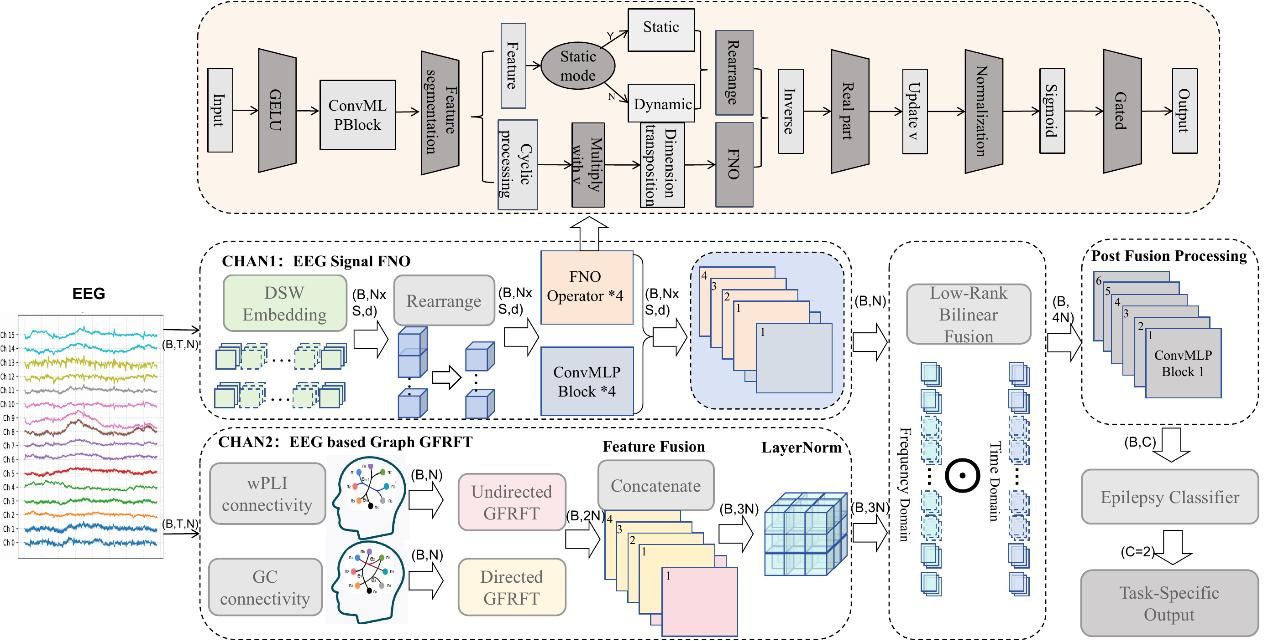
Figure 1 Schematic of the dual‑path EEG‑GraphFrFT framework. CHAN1 performs adaptive time‑frequency analysis via the learnable Generalized Fractional Neural Operator (GFNO). CHAN2 constructs dynamic‑graph functional‑connectivity networks based on wPLI and Granger causality, and extracts dynamic‑graph features through graph fractional‑order operators. Low‑rank bilinear fusion is finally adopted to realise seizure detection.
In the temporal‑modelling path, the team designs the Generalized Fractional Neural Operator (GFNO). Governed by learnable orders that control the rotation angle of fractional Fourier transform, this operator seeks optimal representation bases for non‑stationary signals within the continuous time‑frequency space. Compared with fixed Fourier bases or fixed‑window time‑frequency analysis, the proposed method can more flexibly capture abrupt frequency drifts, chirp‑like transient changes and long‑range‑dependence features in epileptic EEG.
In the graph‑modelling path, the weighted phase‑lag index (wPLI) and frequency‑domain Granger causality (GC) are combined to characterise undirected synchronous coupling and directed Granger predictive relationships between brain regions respectively. To mitigate complex‑spectrum instability that may arise in directed graph computation, the Hermitian graph‑Laplacian construction is adopted. Directional information is encoded into complex phases, preserving directed predictive architecture while guaranteeing real‑spectrum stability of graph operators. Learnable graph fractional‑order filtering is subsequently applied in this graph space to implement adaptive diffusion and discriminative feature extraction for dynamic graph structures.
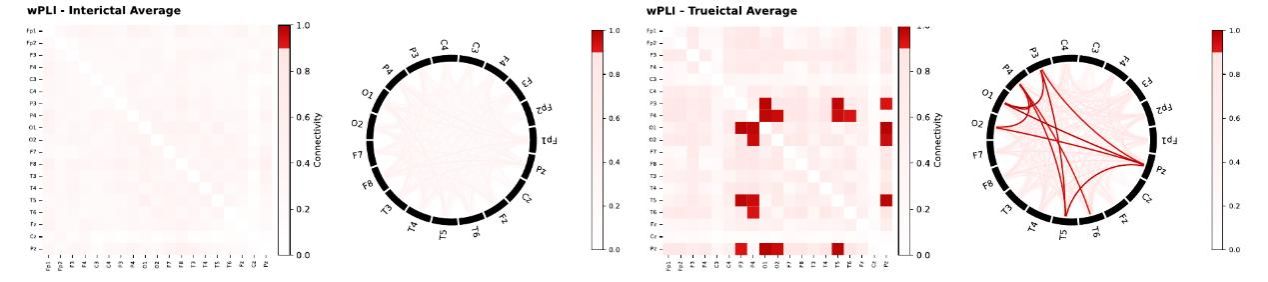
Figure 2 Comparison of functional‑connectivity networks between seizure and non‑seizure states. The wPLI networks reveal sparse connectivity and weak synchronisation during non‑seizure periods, whereas seizure periods exhibit stronger, denser pathological synchronised connections, reflecting rapid reconfiguration of brain functional networks during epileptic seizures.
The work theoretically proves the well‑posedness of fractional‑order graph filters and establishes Hölder‑type stability results under graph‑structure perturbations. The theory demonstrates that fractional heat‑kernel‑type graph filters can maintain stable outputs even when functional‑connectivity estimates are corrupted by noise, edge perturbations or graph‑structural errors. This provides mathematical support for the model’s robust performance on noisy EEG signals and dynamic functional networks.

Figure 3 Model performance comparison under different noise conditions. Experimental results indicate that EEG‑GraphFrFT maintains overall high performance under pink‑noise interference, highlighting the advantages of learnable fractional‑order operators in noise suppression and stable recognition.
To validate the effectiveness of the method, systematic experiments are conducted on three public epileptic‑EEG datasets: FMCE, HUP and Helsinki Neonatal EEG. Experimental results show that EEG‑GraphFrFT outperforms representative models including EEG‑Conformer, Mamba, iTransformer, FreTS and Brain JEPA across multiple evaluation metrics. Specifically, the model achieves an accuracy of 94.54 % on the FMCE dataset, 94.12 % on the HUP dataset and 97.44 % on the Helsinki Neonatal EEG dataset. Under pink noise with standard deviation equal to 1, the model still retains 93.76 % accuracy on FMCE with only minor performance degradation, demonstrating strong anti‑noise capability.
This study establishes a learnable fractional‑order modelling paradigm for non‑stationary graph dynamics. It unifies time‑frequency rotation, graph diffusion and dynamic‑graph functional‑connectivity within a continuously learnable operator framework, delivering new theoretical foundations and algorithmic tools for abnormal‑state recognition tasks such as epileptic‑EEG detection. Beyond brain‑electrical dynamic networks, the method holds promise for broader applications in complex systems characterised by both signal non‑stationarity and topological evolution, such as traffic‑flow status identification, multi‑asset linkage analysis in finance and climate teleconnection modelling.
This research is jointly completed by Ren Zhiwen, Zheng Ruizhe, Chendrayan Dineshkumar, Li Yansong, Du Yang, Yu Yuguo and Han Dingding from Fudan University. Ren Zhiwen and Zheng Ruizhe serve as co‑first authors; Han Dingding and Yu Yuguo are co‑corresponding authors. The research receives support from the Science and Technology Innovation 2030 Major Project of “Brain Science and Brain‑Inspired Intelligence”, the National Natural Science Foundation of China, the National Key Research and Development Program of China, as well as grants from the Shanghai Institute for Mathematics and Interdisciplinary Sciences (SIMIS, SIMISID‑2025‑NC). Computational resources for this work are provided by the Fudan University CFFF Platform.
Article link:https://doi.org/10.1088/2632‑2153/ae8a12
For related reports, please refer to the official WeChat public account of Fudan University Future Information Innovation: https://mp.weixin.qq.com/s/A0SWOwHlCmTecj4STGrzaw