Research Progress
On July 20, a joint research team consisting of Professor Dingding Han from the School of Future Information Innovation and the Laboratory of Fundamental Theory and Key Technologies for Intelligent Complex Systems at Fudan University, Junior Researcher Xiangjin Kong from the research group of Academician Yugang Ma of the Institute of Modern Physics, and Huawei Technologies Co., Ltd. published a research paper titled Program‑Synthesis‑Driven Autodesign of Universal Unitary Operators in Physical Review Letters, a top‑tier and highly influential international journal in physics. This work marks an important advance in the field of AI for Science (AI4S).
With the rapid development of artificial intelligence, quantum information technology and photonic computing, how to efficiently implement high‑dimensional matrix operations on photonic chips has become a critical issue for building large‑scale, low‑power photonic computing systems. Conventional photonic chips rely mainly on manually derived fixed architectures for unitary matrix decomposition. Such design workflows are complex and fail to fully exploit the special structures inherent in different matrices.
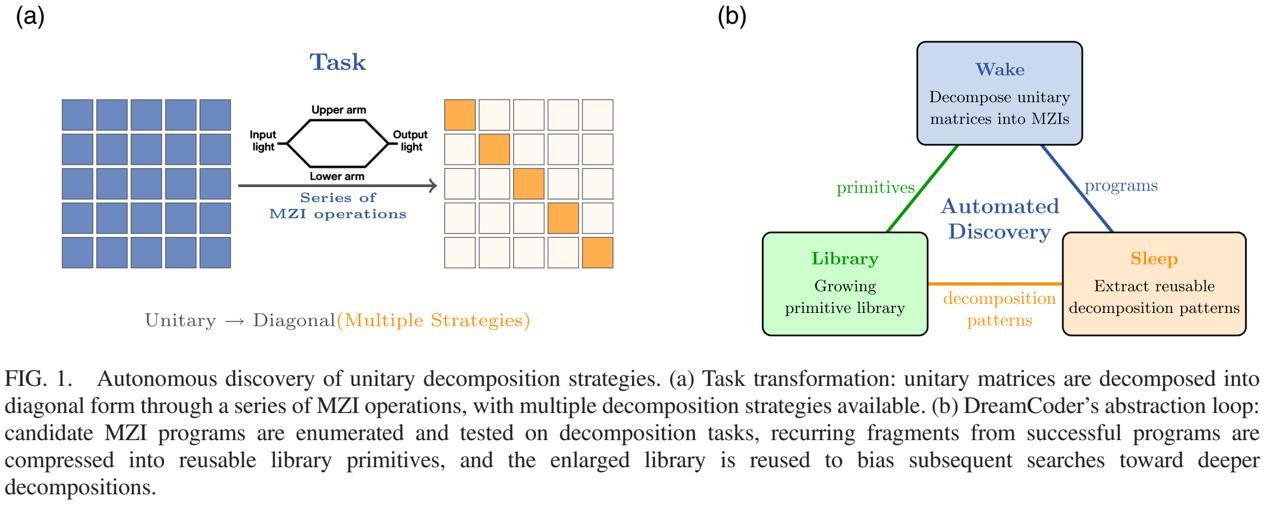
In this work, the team introduced AI program‑synthesis techniques into photonic‑chip design, enabling the system to autonomously search for, validate, and summarize decomposition rules for unitary matrices. Without feeding in pre‑established classical design schemes, artificial intelligence autonomously uncovered multiple novel decomposition pathways distinct from traditional architectures, and extracted generalizable rules from low‑dimensional matrices that can be directly extended to higher dimensions.
For matrices with special structures, the system can further cut down the number of optical components: for the 64‑dimensional Householder matrix, the number of required interferometers is reduced by 93.8 % compared with conventional schemes; for highly‑sparse matrices, component count can be lowered by up to approximately 38 %. These findings are expected to reduce optical loss, calibration complexity and system power consumption of photonic chips, offering new avenues for automated design of photonic computing, photonic neural‑network and quantum‑information‑processing systems.
This study demonstrates that artificial intelligence can do more than data analysis and performance prediction: it is capable of autonomously discovering interpretable algorithmic rules with cross‑scale generalization capability, establishing a new research paradigm for AI‑driven scientific discovery and complex hardware design.
The co‑first authors are Yifei Zhang, a 2024‑entry master’s student at Fudan University, and Dong Chen from Huawei Technologies Co., Ltd. Junior Researcher Xiangjin Kong and Academician Yugang Ma serve as co‑corresponding authors. Professor Dingding Han was deeply involved in innovations bridging artificial‑intelligence methodologies and quantum‑information technologies. This research was supported by the National Key R&D Program of China and the National Natural Science Foundation of China.
Article link:https://doi.org/10.1103/49c3‑4rp4
Related news: Official website of the School of Future Information Innovation, Fudan University https://fit.fudan.edu.cn/Data/View/7016