From August 20 to 23, 2026, the 22th Chinese Conference on Complex Networks was held in Urumqi, Xinjiang. Professor Han Dingding, head of the laboratory, together with postgraduate students Li Yansong, Luo Kaiming, Du Yang and Ye Liqi, travelled all the way to Xinjiang to attend this grand academic event. Experts and scholars from universities and research institutes across China carried out academic exchanges on frontier topics including complex‑network theories, network dynamics, and the intersection of artificial intelligence and network science. Among the participants, Li Yansong took part in the conference’s Excellent Student Paper Defense, while Luo Kaiming, Du Yang and Ye Liqi each delivered academic presentations in relevant sub‑sessions.
Jointly hosted by the Chinese Institute of Command and Control and Xinjiang University of Finance and Economics, organized by the CICC Professional Committee of Network Science and Engineering and the School of Information Management of Xinjiang University of Finance and Economics, and co‑organized by the Professional Committee on Complex Networks and Complex Systems of the China Society for Industrial and Applied Mathematics, the conference set up plenary lectures and thematic sub‑sessions covering complex‑network modeling and structural‑functional analysis, complex‑network dynamics, network control and multi‑agent systems, biological networks, socio‑economic networks, network security, big‑data analytics and artificial‑intelligence computing, higher‑order networks and fractional‑order networks, and other themes. It serves as a vital academic exchange platform for researchers engaged in complex networks and related interdisciplinary fields in China.

The Chinese Conference on Complex Networks is a long‑standing professional academic conference in China’s complex‑network research community. The inaugural conference was held in 2005, and it has since facilitated exchanges on complex‑network theories, methodologies and applications. The Best Student Paper Award targeting young scholars was launched in 2009. The selection generally consists of paper review, shortlist screening and on‑site defense, with experts conducting comprehensive evaluation based on paper quality and on‑site performance. After years of development, the Excellent Student Paper Defense has become a key session for showcasing young researchers’ achievements and boosting the growth of young scholars.
At this conference, Li Yansong was shortlisted for the Excellent Student Paper Award and attended the on‑site defense, systematically presenting his work entitled Learning to Rotate and Diffuse: Unified Fractional Operators for Nonstationary Graph Dynamics. Aiming at the challenge that non‑stationary graph signals cannot be adequately described by fixed time‑frequency representations and fixed graph propagation mechanisms, this study introduces learnable fractional operators to unify the modeling of signal representation and information propagation on graphs, and validates the method on non‑stationary‑data analysis tasks such as electroencephalogram (EEG) signal processing. During the defense, Li Yansong illustrated this work from the perspectives of research background, scientific questions, method design, theoretical analysis and experimental results, and responded to questions raised by the judging panel.


Luo Kaiming delivered an academic presentation titled Steady‑state Solution Algorithm for Open Quantum Many‑body Systems Based on Liouville Eigen‑embedding Variational Neural‑network Ansatz. Focusing on solving the steady states of open quantum many‑body systems, this research combines eigen‑representation in Liouville space with variational neural‑network approaches to explore a novel computational framework for solving steady states of complex open quantum systems. His presentation covered research questions, model construction, solution algorithms and experimental outcomes, and he exchanged ideas with on‑site experts and scholars on topics including open‑quantum‑system modeling and intelligent computing methods.

Du Yang gave a report entitled PLV‑guided Classical‑quantum Hybrid Complex‑network Model for Motor‑imagery EEG Classification. Centered on motor‑imagery EEG‑signal classification, this study characterizes functional connections among brain regions using phase‑locking value (PLV), and integrates complex‑network modeling with classical‑quantum hybrid learning to model spatial correlations and network‑structural information embedded in EEG signals. The presentation demonstrated interdisciplinary research ideas combining complex networks, EEG analysis and quantum machine learning, and sparked discussions with participants on model design and experimental results.
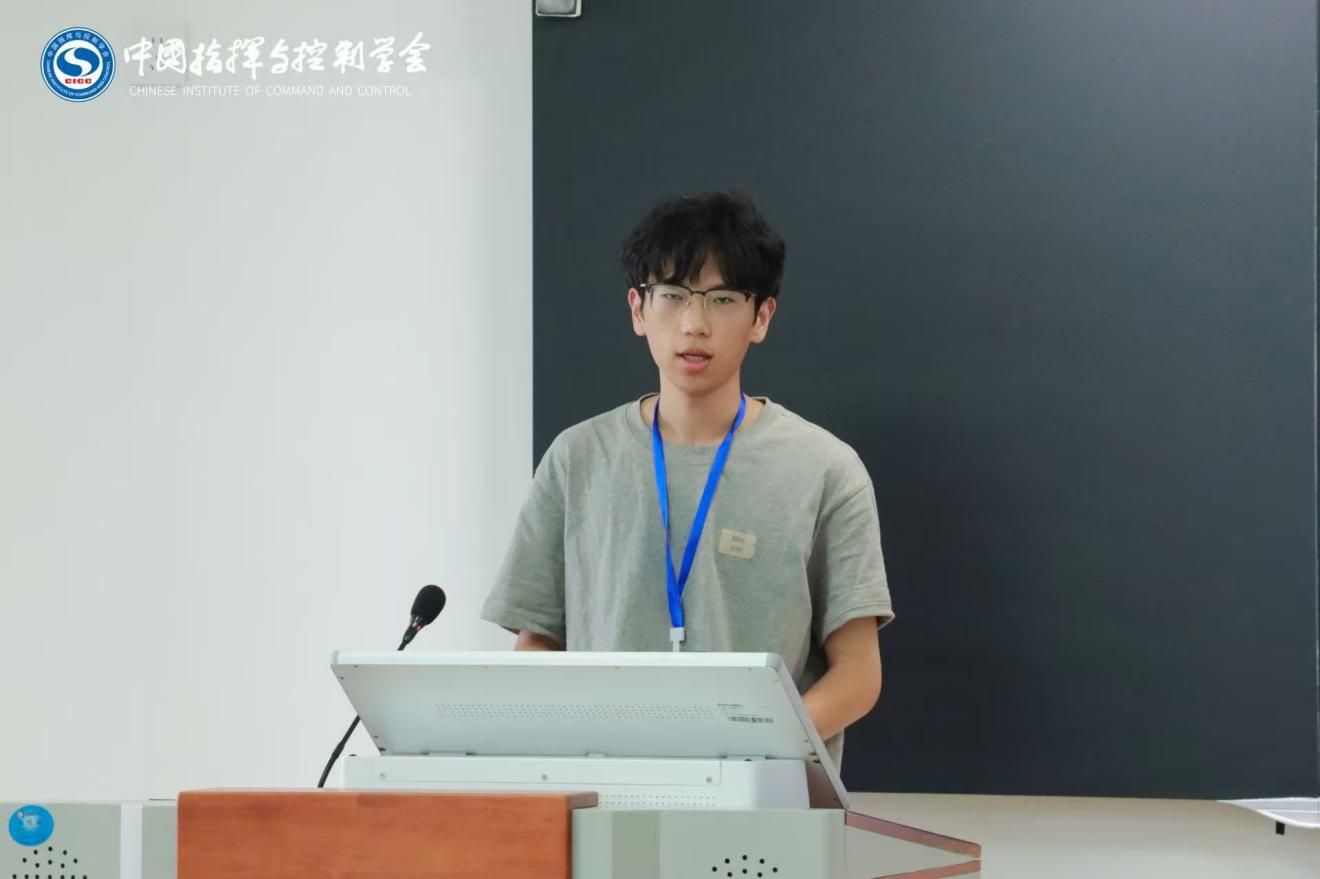
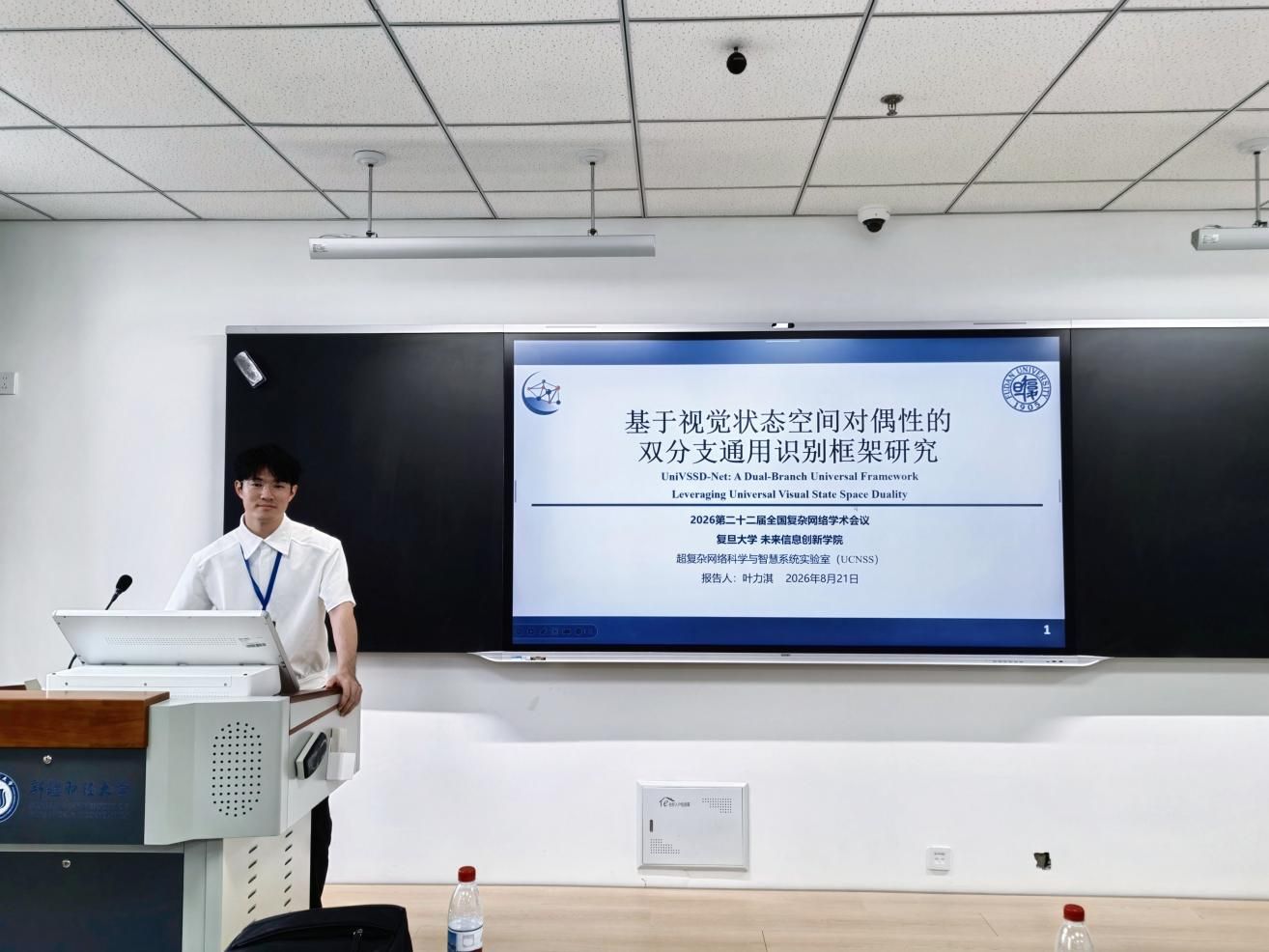
Ye Liqi presented his work Research on Dual‑branch Universal Recognition Framework Based on Visual State‑space Duality. Starting from visual state‑space modeling, this study explores the complementarity and duality between different representation mechanisms, and constructs a dual‑branch universal recognition framework to boost models’ capacity for representing and recognizing complex visual information. He introduced the fundamental ideas, overall framework and experimental results of this research, and communicated with attending scholars on state‑space models and visual recognition.

During the conference, Professor Han Dingding attended the students’ presentations and academic sessions, following closely the display and discussion of relevant research work. The joint participation of teachers and students not only showcased the laboratory’s recent research advances in frontier directions such as complex networks and complex systems, AI4Science, quantum regulation and visual intelligence, but also offered precious opportunities to learn about cutting‑edge domain progress, collect peer feedback and broaden research perspectives. Attending the 22th Chinese Conference on Complex Networks constitutes an important opportunity for laboratory faculty and students to present phased research outcomes and conduct academic communication. Through excellent‑student‑paper defense, special‑session presentations and in‑person discussions with experts, the students have broadened their academic horizons and deepened their understanding of relevant research problems. Going forward, the laboratory will continue to carry out systematic, in‑depth research at scientific frontiers including complex networks and complex systems, artificial intelligence, brain and cognitive computing, and quantum regulation. It will encourage young students to actively participate in high‑level academic events, so that they can refine research thinking and strengthen scientific‑research innovation capacity through communication and discussion.