On Children’s Day (June 1), our laboratory celebrated another cohort of graduate students defending their dissertations, a joyous milestone worth celebrating!
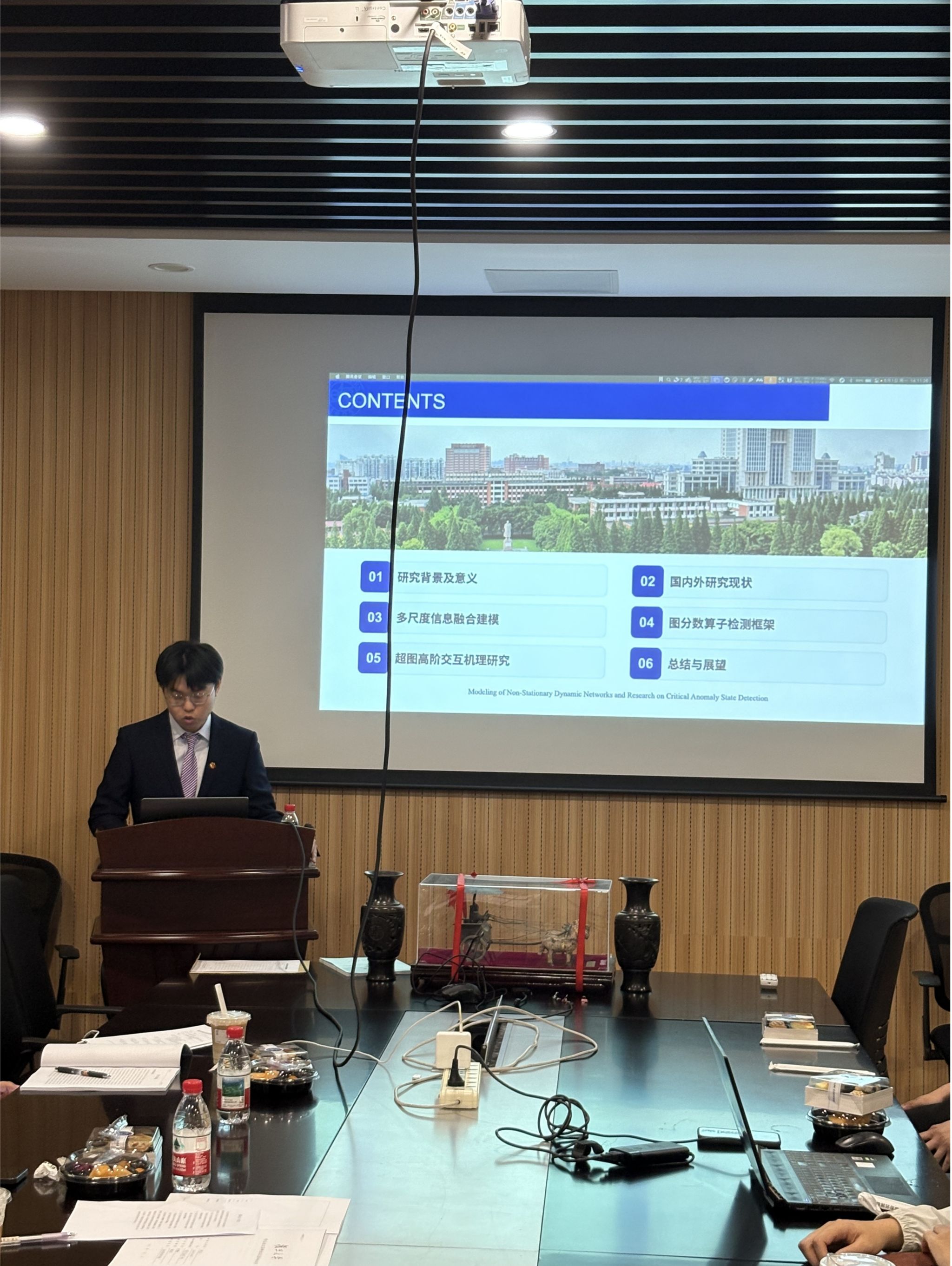
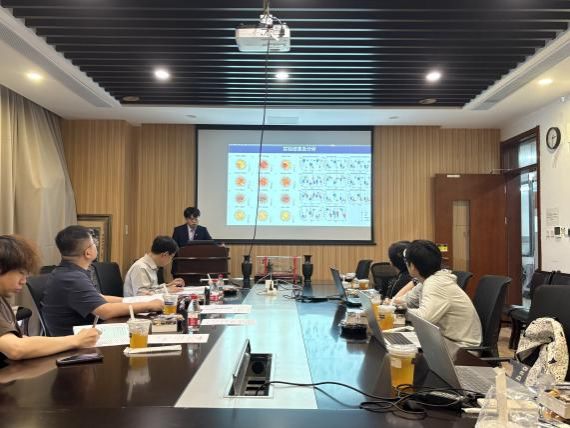
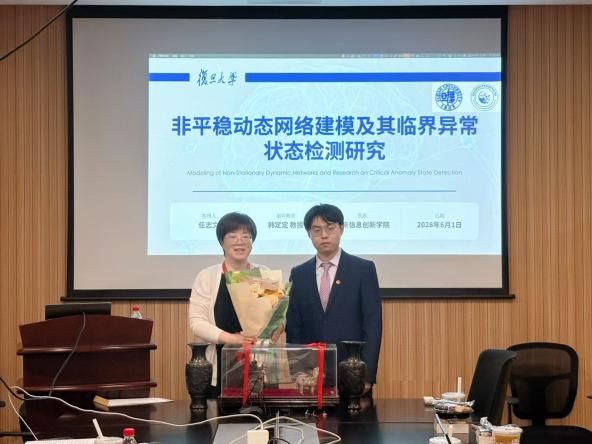
On the afternoon of June 1, Ren Zhiwen, a postgraduate student of our laboratory, defended his master’s/doctoral dissertation under the supervision of Professor Han Dingding. The dissertation defense committee consisted of Professor Chen Mingsong from East China Normal University, alongside Professors Xu Yuedong and Leng Siyang from Fudan University. Professor Chen Mingsong chaired the defense, and Lecturer Liu Yijun served as the defense secretary.
Ren Zhiwen’s dissertation is titled Modelling of Nonstationary Dynamic Networks and Detection of Critical Anomalous States. As a core analytical framework for depicting the evolutionary internal interactions of complex systems, nonstationary dynamic networks boast promising applications in investigating critical phase transitions across functional brain networks, financial markets and many other fields. Nevertheless, systems typically exhibit dual features near criticality: nonstationary signal behaviours such as instantaneous frequency drift, coupled with time-varying network topology. Despite substantial advances in dynamic network modelling and anomaly detection in recent years, prevailing methodologies mostly adopt single-scale analysis with fixed frequency bands or time windows, while conventional time-frequency analysis and static graph operators fail to accommodate signal nonstationarity effectively. Moreover, existing models are predominantly built upon pairwise node-edge structures, lacking in-depth exploration of high-order interaction (HOI) mechanisms triggering systemic instability, which compromises the sensitivity, noise robustness and physiological interpretability of critical anomaly early-warning systems. Accordingly, developing a detection framework that accommodates dual nonstationarity of signals and topology and unravels evolutionary mechanisms of high-order networks has become a pivotal research priority in this field.
Against this backdrop, the dissertation takes epileptic electroencephalogram (EEG) dynamic networks—characterized by prominent dual nonstationarity—as the primary research subject, establishing an integrated closed-loop theoretical and computational framework spanning underlying network modelling, anomalous state detection and physical evolutionary mechanism interpretation. Three core investigations are conducted: multi-scale information fusion-based network construction, a learnable graph fractional operator-enabled detection architecture, and criticality mechanisms behind high-order hypergraphs, aiming to improve the precision and sensitivity of critical anomaly detection and reveal high-order evolutionary laws governing anomalous network transitions.
The research outputs have earned high recognition from domestic and international peers, with relevant findings published in top-tier international journals as listed below:
REN Z, HAN D. A multi-scale information fusion approach for brain network construction in epileptic EEG analysis[J]. Physica A: Statistical Mechanics and its Applications, 2025, 661: 130415.
REN Z, ZHENG R, DINESHKUMAR C, et al. Learning to Rotate and Diffuse: Unified Fractional Operators for Nonstationary Graph Dynamics [J]. Machine Learning: Science and Technology, 2026 (manuscript received).
After rigorous review, all committee members agreed that the dissertation features a research topic of profound theoretical significance and practical application value. With complete structural layout, coherent logical reasoning, standardized formatting, authentic experimental data and rigorous analytical procedures, the work delivers innovative research outcomes. During the defence, Ren Zhiwen presented clear thinking and gave accurate responses to committee queries, demonstrating solid command of fundamental disciplinary theories, systematic specialized expertise and the capability to conduct independent scientific research. By anonymous ballot, the defence committee unanimously approved his dissertation defence and recommended the thesis for Outstanding Dissertation honours.
Amid the new round of technological revolution, the laboratory has deployed cutting-edge research covering big data, artificial intelligence, digital twins, brain science and quantum technology to build an interdisciplinary innovation and practice platform. It has forged robust collaborative partnerships with numerous enterprises, universities and research institutes, emphasizing the integration of theory with practical application to cultivate students’ engineering capabilities.
Led by Professor Han Dingding, a Tenure-Track Professor at Fudan University, the laboratory boasts an outstanding graduate training track record. Many of her supervised students have been awarded provincial- and university-level Outstanding Graduate honors, with the postgraduate employment rate consistently hitting 100%. Graduates have secured careers at leading industrial firms including Huawei, Alibaba, Tencent and Bilibili. Others join research institutes and universities, while a fraction work as selected civil servants or in government authorities to fuel local economic and social development.