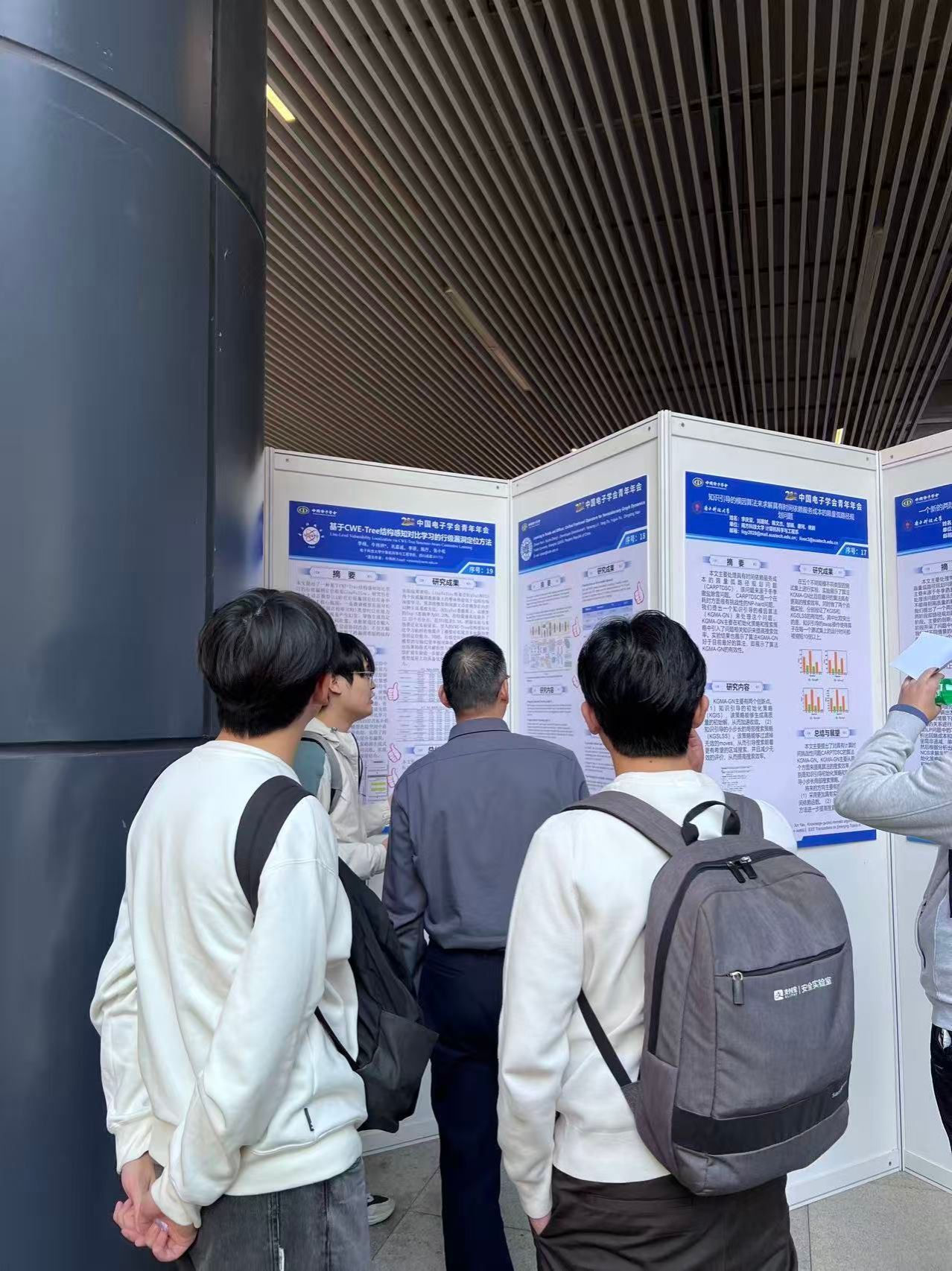
To unite and guide young scientists and engineers in taking active responsibility and serving the nation's major strategic needs, and to promote academic exchange and innovative collaboration among young professionals in the electronic information field, the Chinese Institute of Electronics (CIE) held the 28th CIE Youth Conference on 20–22 November 2026 in Shenzhen, Guangdong Province. Themed "All in AI: Shenzhen Sparks the Wave of Intelligence," the conference organized a number of thematic forums, youth salons and a series of youth innovation service activities. To fully stimulate the innovative and creative vitality of young talent, the conference established a dedicated Youth Paper Achievement Exchange session, featuring paper presentations, poster displays and on-site interactive discussions.


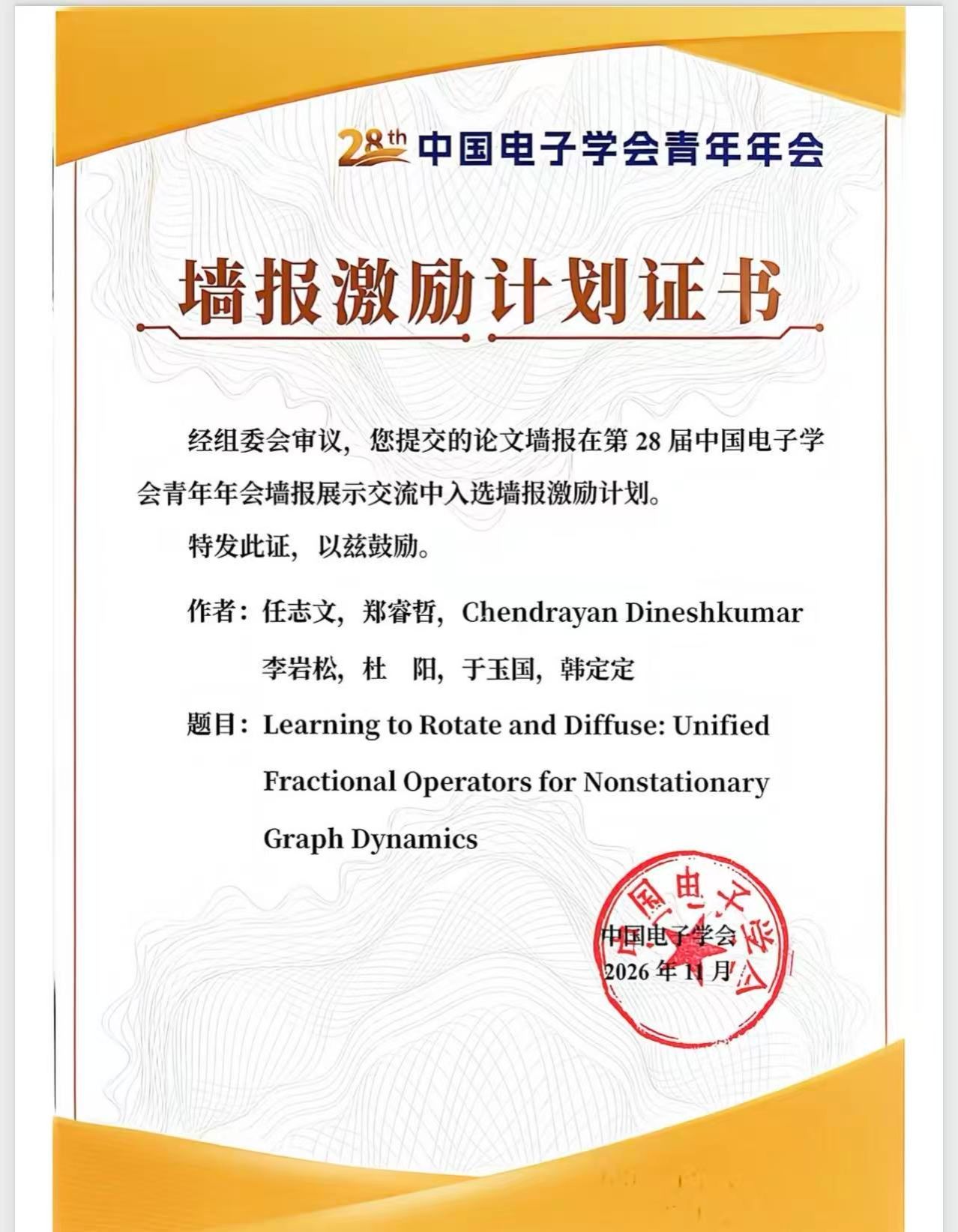
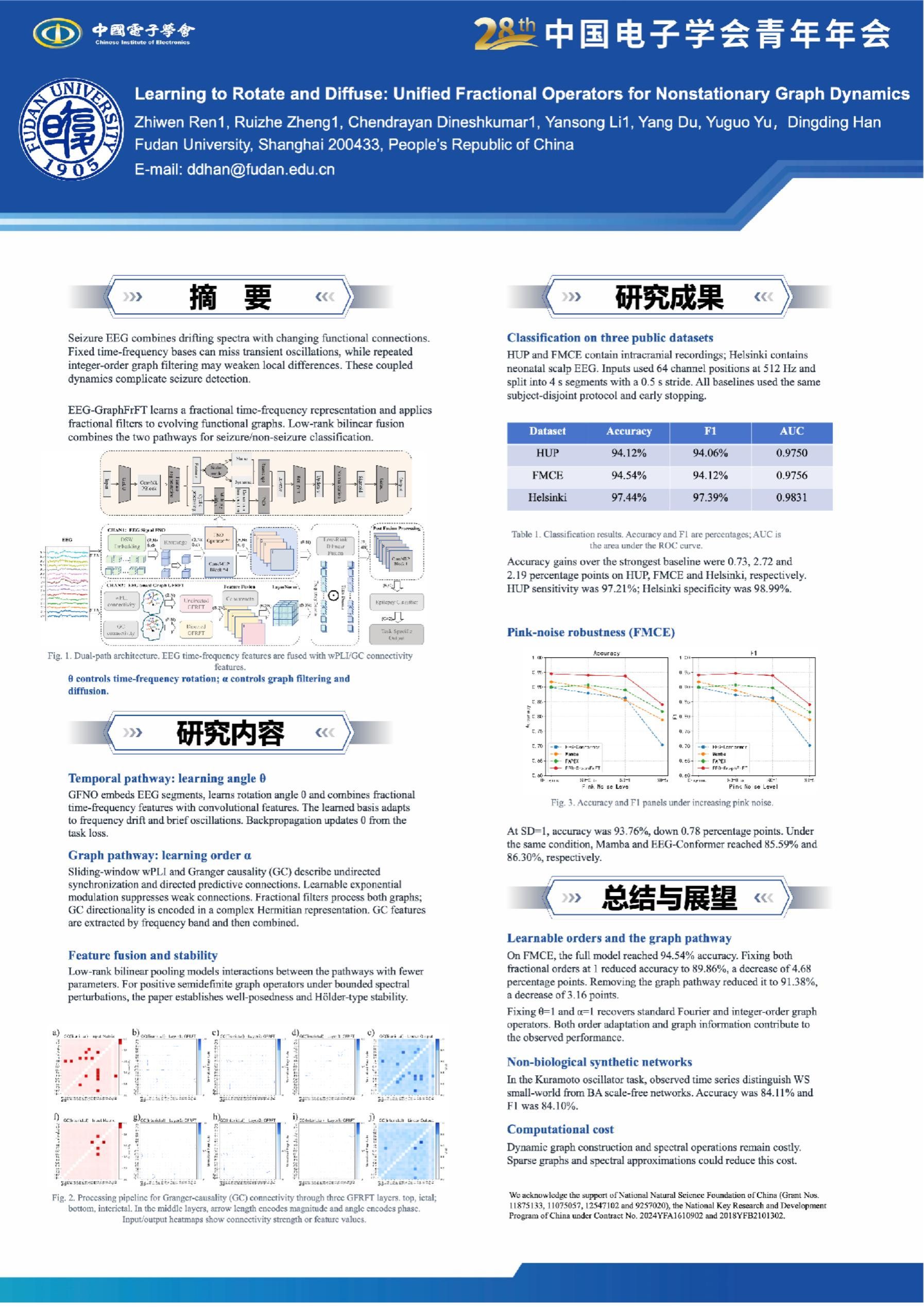
In the run-up to this year's conference, a total of more than 190 papers were submitted. Following an initial review organized by the conference organizing committee with expert reviewers, 85 papers were selected for on-site poster presentation and discussion. During the conference, review experts visited the venue for discussion and scoring; after tallying the "like" votes together with the experts' scores, 20 poster papers were selected for the conference's Poster Incentive Program. Our laboratory's research result, "Learning to Rotate and Diffuse: Unified Fractional Operators for Nonstationary Graph Dynamics," was selected for the Poster Incentive Program of this year's conference. Warm congratulations!
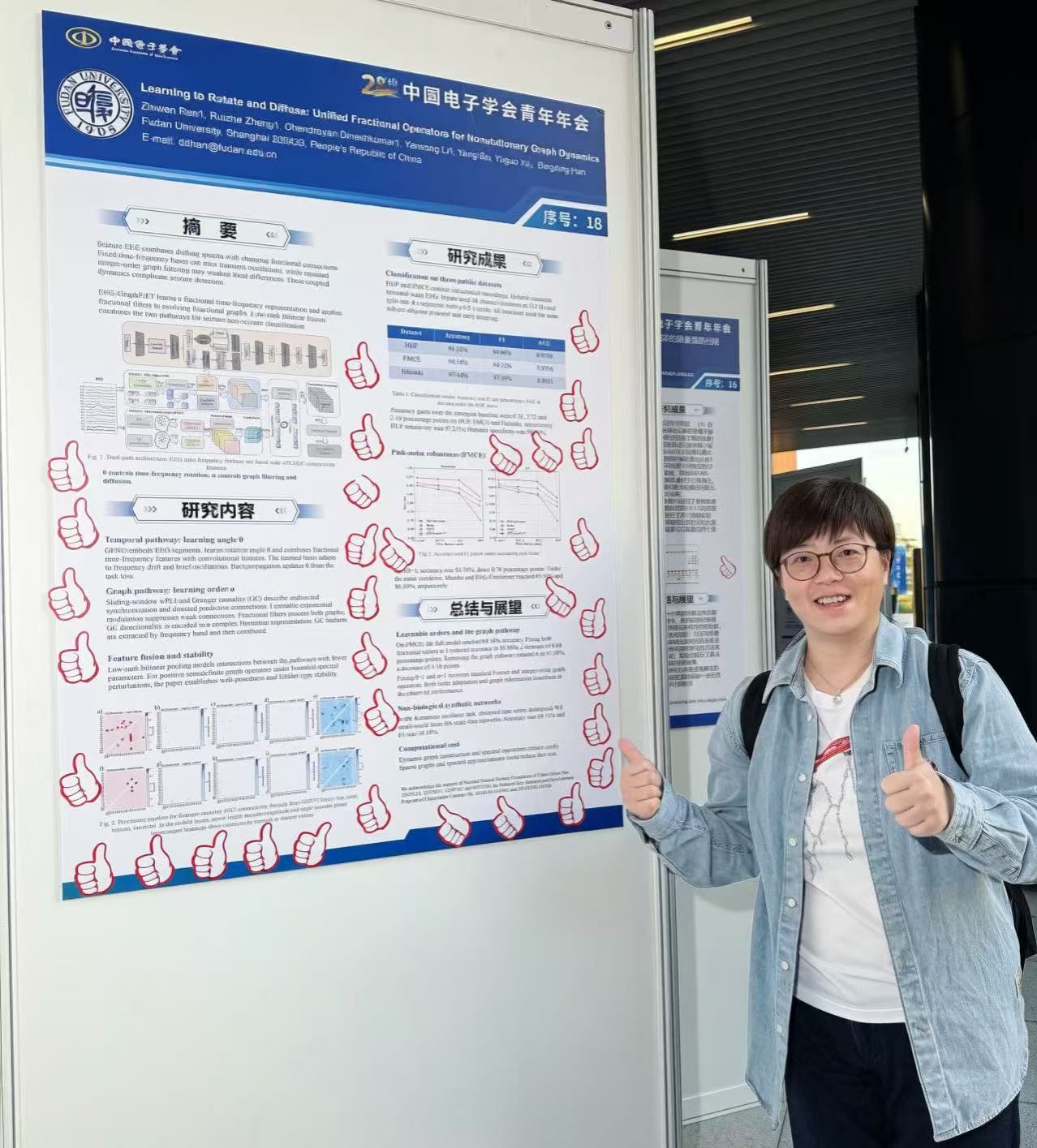
This study addresses the modeling problem in which time-varying node-level temporal characteristics and the dynamic evolution of network connectivity coexist in nonstationary graph signals, and proposes a dual-pathway framework, EEG-GraphFrFT. The model employs a learnable fractional Fourier transform and fractional graph operators, respectively, to adaptively handle time–frequency variations and dynamic functional networks, and fuses the two types of features through low-rank bilinear fusion. The work further establishes the well-posedness of fractional graph filtering and Hölder-type stability results. In the task of epileptic EEG recognition, the proposed method achieves classification accuracies of 94.12%, 94.54% and 97.44% on three public datasets, HUP, FMCE and Helsinki, respectively, and its effectiveness is verified through noise robustness tests and ablation studies. The study also conducts experiments on Kuramoto synthetic dynamic networks to examine the applicability of the framework to non-biological graph signal tasks.