Recently, the Symposium on Interdisciplinary Research in High-Order Graph Neural Networks organized by our laboratory was successfully held at Building 2 of Interdisciplinary Sciences, Jiangwan Campus, Fudan University. The symposium brought together experts, scholars and young researchers in the field. Professor Dingding Han, Professor Yuguo Yu, Ruizhe Zheng, Chendrayan Dineshkumar, Zhiwen Ren, Yang Du, Yansong Li and Liqi Ye (online) attended the symposium.
The core purpose of this symposium is to conduct in-depth academic exchanges on recent research progress, research challenges and follow-up plans. The conference adopted a compact and efficient agenda: five speakers delivered 15-minute research presentations respectively, with 5–8 minutes of dedicated discussion time reserved for each presentation, ensuring sufficient discussion and academic exchanges among participants.
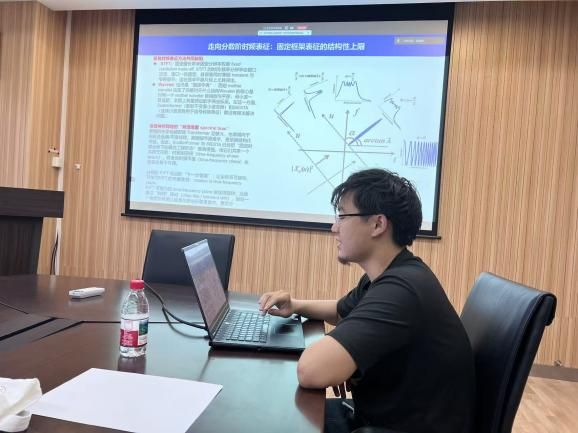
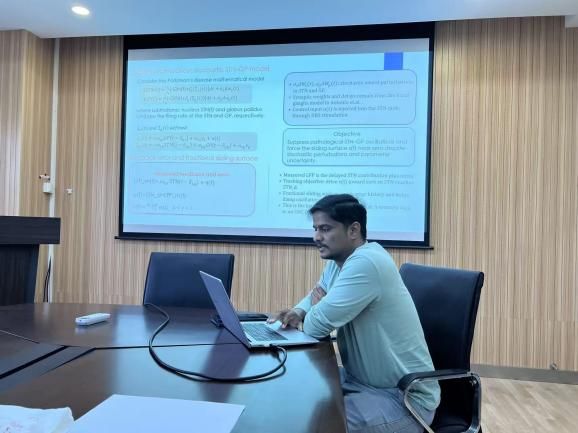
In the academic presentation session, five researchers shared the latest progress in their respective fields in sequence:Ruizhe Zheng gave the first presentation entitled Fractional-Order Time-Frequency Perspective for Temporal and Spatiotemporal Prediction. He deeply analyzed the path toward fractional-order time-frequency representation, and focused on the structural upper bound and time-frequency resolution trade-off issues faced by existing fixed-frame representation methods (such as STFT and Wavelet) when processing complex signals.Chendrayan Dineshkumar presented Fractional-Order Random Sliding Mode Controller for Improving the Robustness of Closed-Loop Deep Brain Stimulation Systems. He introduced his research on the application of fractional-order sliding mode control in deep brain stimulation systems for Parkinson’s disease, aiming to improve the robustness of the system against noise and uncertainties.
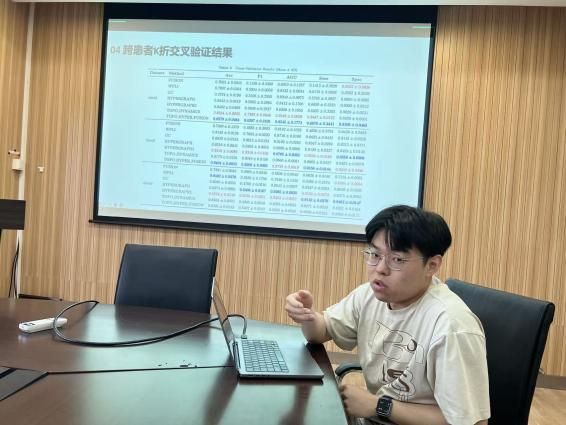
Zhiwen Ren shared his work titled High-Order Brain Network Modeling and Mechanism Analysis Based on Hypergraphs and Simplicial Complexes. At the symposium, he presented detailed data from cross-patient K-fold cross-validation, and directly compared the performance of hypergraphs, topological dynamics, and multimodal fusion methods on core metrics including accuracy and F1-score.
Yang Du focused on the intersection of brain–computer interfaces and quantum computing, reporting on Research on Motor Imagery EEG Signal Classification Based on Classical–Quantum Hybrid Neural Networks.
Liqi Ye gave a detailed presentation entitled Research on Dual-Branch Universal Recognition Framework Based on Visual State-Space Duality.
This symposium coincided with the 121st Anniversary of Fudan University. Our laboratory brought together domestic and international experts and young researchers from both inside and outside the university to celebrate this grand academic event. The venue was filled with a strong academic atmosphere. Attending experts provided detailed comments on each presentation, pointing out existing challenges in current research and offering highly valuable guidance for subsequent optimization.